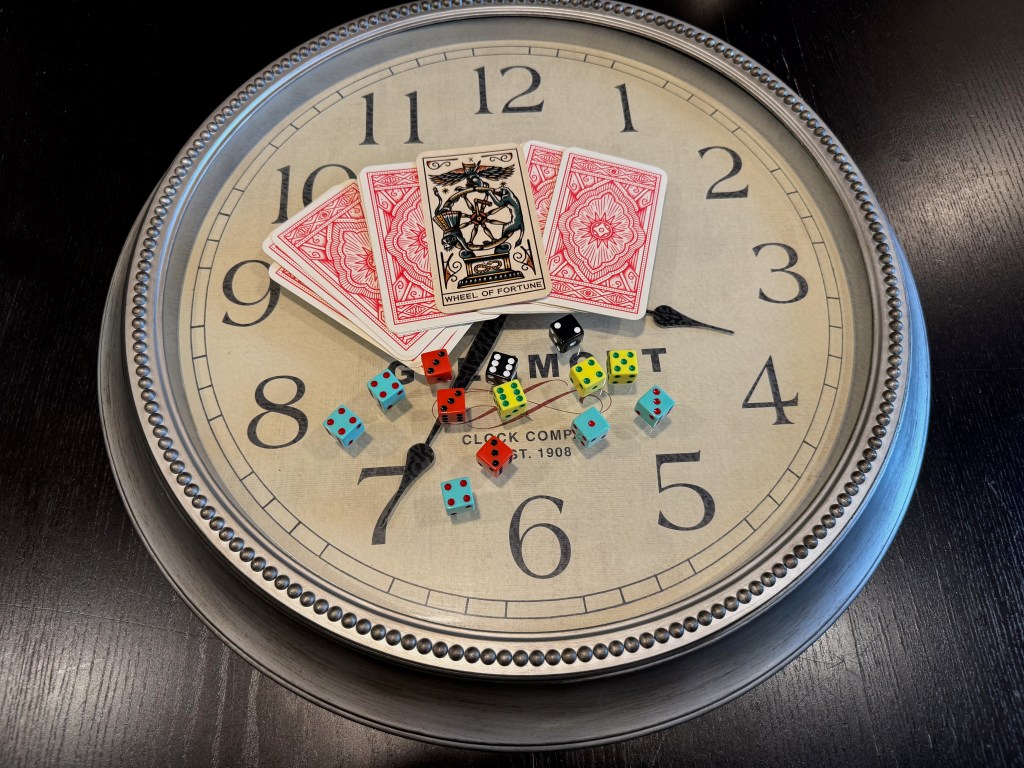
The Deck Doesn’t Know You. That’s the Point.
There’s a debate that runs quietly underneath almost every tarot reading. On one side: the believers, who hold that the cards you draw are guided by the universe, by fate, by something beyond the shuffle. On the other: the skeptics, who are pretty sure it’s just cardboard and coincidence.
I’m not here to settle that argument. For what I do, it doesn’t matter.
Because here what both sides can accidentally agree on: nobody in that room chose those cards. Whether fate dealt them or entropy did, the choice didn’t come from you, and it didn’t come from me. And that shared feature — that absence of human authorship — turns out to be one of the most powerful things about a tarot reading.
Randomness Is a Feature, Not a Bug
There’s a concept gaining traction in psychology and organizational research called empowered randomness: the deliberate, strategic introduction of chance into structured environments. The idea is that unpredictability isn’t a threat to good outcomes. It’s a tool. Controlled randomness helps break analysis paralysis, spark unexpected connections, and build systems that are more robust precisely because they can’t be gamed.
This isn’t abstract theory. Randomness has been quietly doing heavy lifting across a surprising range of fields for a long time.
During World War II, operations researchers in the Bay of Biscay used randomized search patterns to locate German submarines leaving France, because their predictable search patterns allowed the subs to evade detection. The Naskapi people of eastern Canada have hunted by reading the random scorch marks on burned caribou bones for centuries, a strategy that prevented them from depleting any single region of forest. As Nate Silver and others have noted, poker players sometimes glance at a clock or watch to make a decision, using that random input to stay unpredictable against opponents who are constantly modeling their behavior.
Engineers who’ve worked in signal processing will recognize the concept of dithering: adding a small amount of random noise to an analog signal before converting it to digital. It sounds backwards, but that noise actually improves resolution, smoothing out the quantization errors that would otherwise distort the measurement. More randomness, better signal.
The pattern across all of these: controlled randomness breaks out of ruts. It sidesteps the predictable grooves that human cognition wears into repeated decisions. It keeps one’s own biases from running the show. That’s important, because those biases get in the way when thinking about difficult topics.
The Ego Needs an Author
Think about what happens when someone raises a difficult topic directly. Ask a not-that-close friend how things are really going in their marriage, and you may see the shutters come down. They get careful. They guard what they share.
Now put on a movie where two characters are navigating a rocky relationship, and have that same conversation after. You may find your friend suddenly more animated, insightful, and maybe even uncomfortably specific. They’re drawing parallels you didn’t ask for. Because they’re talking about those characters, not themselves. The topic is the same. The defenses are not.
Therapists have understood this dynamic for a long time. When the stimulus is external and unchosen, projection happens naturally. People will tell you exactly what they’re thinking, as long as they’re technically talking about something else.
Here’s what this means for a tarot reading. If I were to look at your situation and hand-select a card I thought was relevant, you’d immediately feel the weight of that choice. Why that card? What is he saying about me? What does he think is wrong with my situation? The defenses go up, and the reading becomes about managing your reaction to my judgment rather than genuinely exploring what the cards might surface.
But I didn’t choose those cards. Nobody did, in any way that implicates either of us. So there’s no author for your ego to argue with. The card just landed there, seemingly randomly, and all that energy that would have gone into self-protection gets redirected somewhere more interesting.
Your Brain Hates Ambiguity (In the Best Possible Way)
Here’s where psychology gets useful. Human brains are pattern-completion machines. We are incapable of sitting with unresolved ambiguity. We see shapes in clouds. We hear melodies in noise. We invent narrative connections between things that may have no actual relationship. We can’t help it.
This is exactly what makes the Rorschach test and the Thematic Apperception Test (TAT) work. In the Rorschach, subjects look at a series of abstract inkblots and describe what they see. In the TAT, they’re shown ambiguous illustrations of people in various situations and asked to tell a story about what’s happening. Neither test has a right answer. That’s the point. The ambiguity forces your brain to fill in the blanks, and what you fill them in with is the data.
Tarot operates the same way. A card lands on the table and your brain immediately starts resolving it: What does the figure in that image remind me of? Why does that scene make me uncomfortable? Why did I immediately think of my situation at work? You’re not receiving a message. You’re generating one. As I wrote in The Global API, the cards are essentially clicking icons in your subconscious database, triggering associations that were already in there waiting to be surfaced.
The ambiguity of the draw isn’t a weakness. It’s what makes the whole thing work. A card your reader had deliberately chosen for you would carry their meaning. A card that arrived without an author carries yours.
The Randomness Made You Look
So: did fate choose your cards? The universe? The particular chaos of a well-shuffled deck?
I don’t know. Nobody does.
What I do know is that those cards are on the table and they didn’t come from either of us. Whatever force — cosmic or statistical — put them there has already done the most important thing: it got your ego out of the room.
What you see in those cards, what resonates and what stings, what you immediately want to dismiss… that’s not the universe talking. That’s you.
The randomness just made you look.

 Tarot for Good
Leave a comment