Synchronicity: When the Cards Know Things They Shouldn't
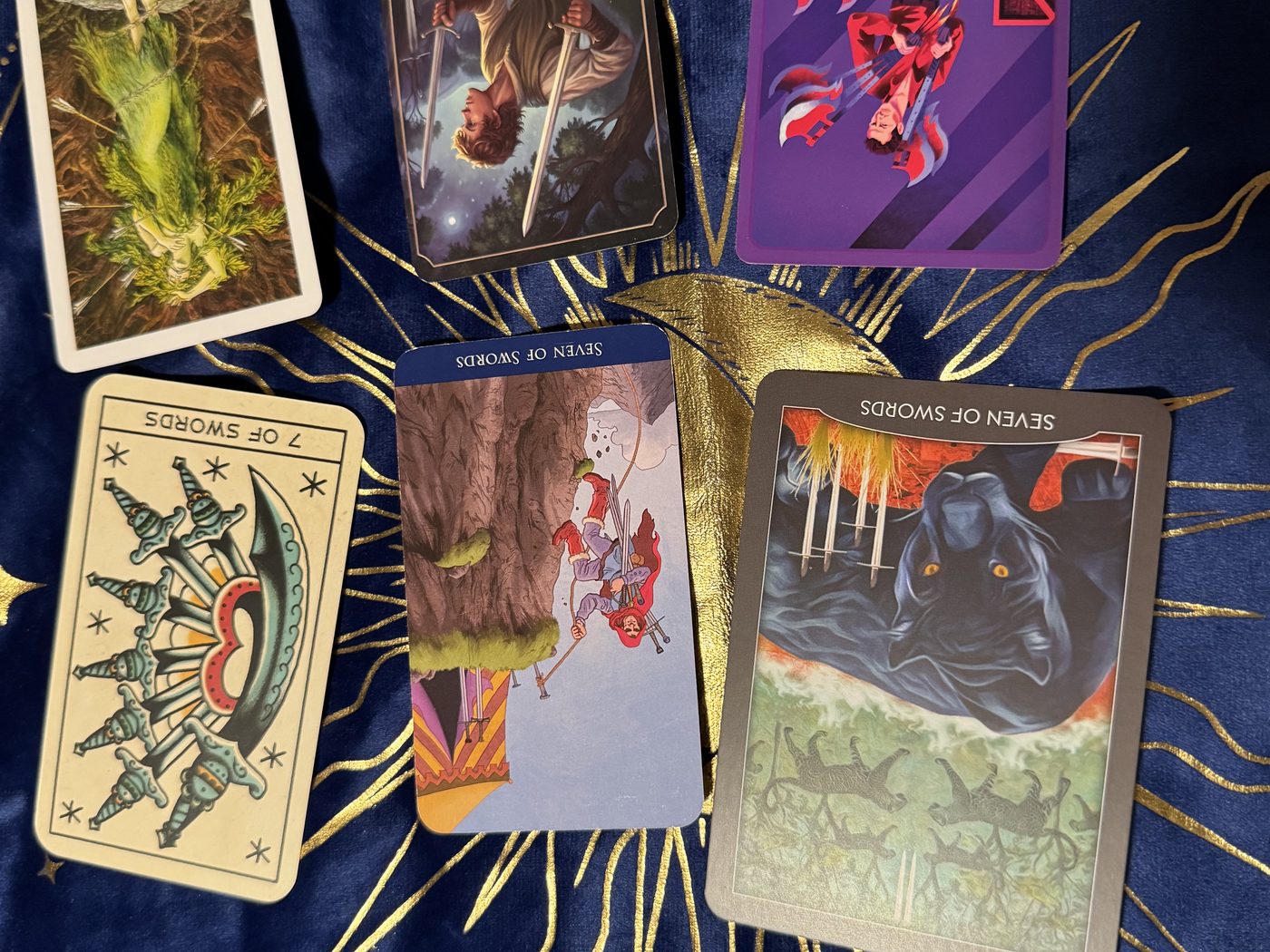
"Wow... so that's the second time I've drawn this Seven of Swords reversed this evening. That suggests there's something sneaky or underhanded that's been going on but that it's being exposed. Maybe this means something to you...?"
My seeker made an inscrutable face. "Yes, it does. You drew the same card for my partner about three people ago when she sat here. We're both dealing with the same situation."
Stunned. Just stunned. Two people I'd never met before, who I didn't know were connected in any way, and who weren't back-to-back. There I was at the fair, humming along, reading person after person, with shuffles and cuts and seeker-picked cards... and this unexplainable coincidence still happened. I felt that flutter in my chest; y'know, the one you get from a great magic trick or a medium describing your grandma's favorite hat. How did that card land there twice?
It happens just often enough that I'm less surprised than I used to be. A seeker smiles and shows me their moon tattoo that matches the Moon card I just drew. Another seeker laughs when I tell her the last card drawn, the Four of Cups reversed, means an end to boredom; it turns out she booked the reading because, as she told her friend, she wanted to not be bored. I didn't know any of this going in. The cards just... landed.
Those moments are unsettling. Not in a spooky way. In a how the hell did I do that? way.
The Rational Explanation: Synchronicity
Enter Carl Jung. He spent decades noticing the same thing: patients' internal states would mirror external events in ways that couldn't be explained by cause and effect. He called it synchronicity: meaningful coincidences connected not by causality but by significance.
Okay, sure, it's a hand-wavy explanation, but it is a rational instead of a mystical one. Synchronicity says the cards aren't predicting the future or reading minds. Instead, your internal state — your subconscious preoccupations, your patterns, what you're actually worried about or drawn to — can line up with otherwise random external events. Like when you're thinking of getting a new car, and then you notice that car everywhere on the road. Or you're thinking about a friend, and they choose that moment to give you a call.
In other words, it's highly unlikely the card and the matching tattoo are connected by magic. The moon is simply part of their identity. So when I draw the moon, it lands... and not because I have superpowers. Because while I'm providing the reading, the cards become a mirror for what's already moving inside you. The card and the tattoo are both expressions of the same underlying part of that seeker's psyche, and so we notice when they pop up.
Synchronicity lets you keep your rational brain intact while explaining why tarot isn't just noise. It provides a non-mystical mechanism. Whew, my beliefs are safe.
How Rational Is It, Though?
Except synchronicity itself is kind of weird, isn't it?
Jung was proposing that the universe allows internal and external events to align meaningfully without any causal chain connecting them. That's not exactly Newtonian physics. The more you think about it, the more you realize synchronicity is not so much a solution; it's more like a sophisticated reframing of the same mystery.
One could argue that synchronicity is just a fancy name for pattern-matching. Our brains are built to find connections. You only notice the moon card because she has a moon tattoo. We notice when it matters, so it feels like a one in a million coincidence. We don't notice the other 999,999 misses. So it's confirmation bias dressed up in German philosophy.
Taken even further, what if synchronicity is a placeholder for something we don't yet have language for? For how our minds and reality interact in ways that sit outside our current models of the universe? Before you discount that idea out of hand, think of all the times humanity "knew" something that was wrong. We needed Copernicus and Galileo to tell us the Earth wasn't the center of the universe. Until germ theory became accepted in the 1890s, scientists believed smelly air was what transmitted diseases. And quantum entanglement (which Einstein described as "spooky action at a distance" still baffles modern day physicists.
Science keeps surprising us. Maybe there IS a universe-to-card connection we don't know about yet.
My path is to hold both possibilities at once. There's a concept in so-called professional wrestling called kayfabe: the wrestlers and audience effectively agree to maintain an illusion of reality. The audience is pretty sure there's a script, but they suspend disbelief enough to wonder if it's real. That's where I personally sit with tarot. I know the mechanism. I understand the psychology. And yet, when those cards land, there's something that makes me wonder if there's more to it. I'm not sure what it is. And you know what? I'm okay not being sure.
So What's the Answer?
I don't know, and neither do you. The only way either of us figures it out is by staying curious and running more experiments.
That's what these readings are for me — a chance to watch synchronicity in action, to notice where the pattern-matching ends and something else might begin, to sit with the question instead of dismissing it too quickly. Every seeker who walks in is another data point. Every unexplainable coincidence from a "hit" is another moment to wonder.
You want to know if tarot is real? Book a reading. Pay attention. Draw your own conclusions. The cards don't have answers. But they're excellent at asking better questions.