"Are You Free?" Readings at the Church Fair
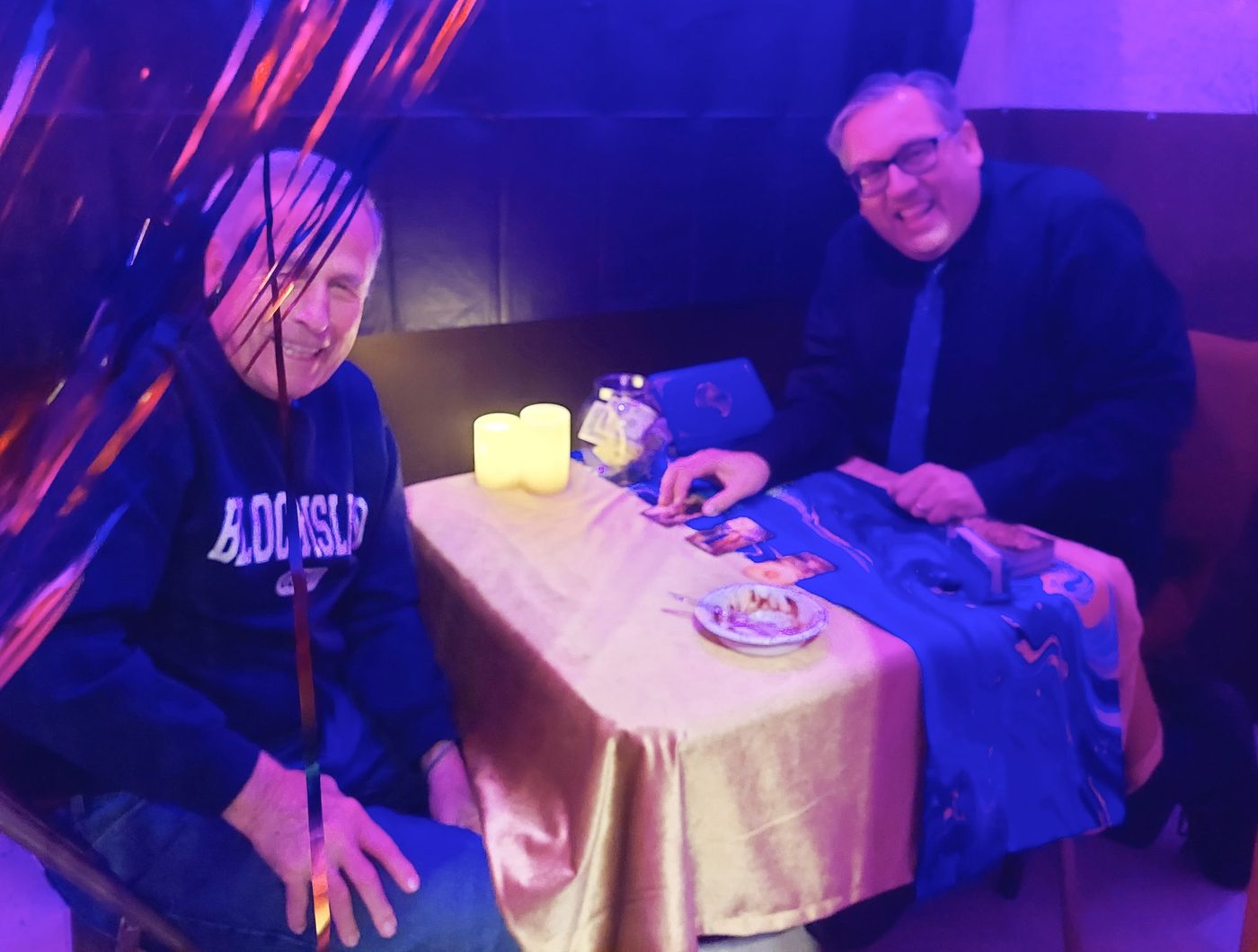
The scene before me: a folding table adorned with a gold tablecloth, a blue runner, two battery-operated candles, a donation jar, my notebook, and one of my tarot decks. Purple lights strung overhead by the helpful crew at Aldersgate United Methodist Church cast the whole interior in a soft glow. My matching purple, constellation-covered tie adds a little flair to my dress blacks. Colored streamers cover the doorway to this repurposed closet. Above the entrance, a sign reads Foley the Fantastic to match the circus fair theme. (While I appreciated the organizers' compliment, these readings aren't really about me... but I played along.) Outside the streamers, the church's fundraiser runs: food booths, a cakewalk, the sound of a community doing what communities do.
Then a hand parts the streamers. A face appears.
"Are you free?"
Sixteen times that evening, the answer was yes.
Who Shows Up
Over an hour and a half, I read for people who had nothing obvious in common. High schoolers and retirees. Parents who brought their kids along. Some people I've known for years, and some who were fresh faces. Many had wandered over from other booths without really knowing what a tarot reading was. Some had sat for readings before and arrived with a sense of what to expect. Others came in skeptical and ready to push back. Still others were simply curious, drawn in by the sign and a few free minutes.
The questions were similarly varied. Some were light: near-term decisions, advice on a hobby, or where to focus attention this summer. Some were weightier: serious questions about health, relationships, or a life that was transforming... the kind of questions that take a few minutes to fully digest. A few people arrived with the question they thought they had, but we spent the reading figuring out what they were really asking.
The interesting thing was how many of them had never had a reading before.
That's what a live event does that a private booking can't. Someone sees a sign, decides to pop in, and suddenly they're sitting across from the cards for the first time. They don't know what to expect — they're just there, with whatever mental load they brought with them that evening. And that turns out to be enough. There's something different about reading for someone who hasn't arrived with expectations about what tarot should do. They're not trying to confirm a belief or test a hypothesis. They're just fully present with a question.
Best of all? On the way out, many told me, "I enjoyed that more than I expected to."
Five Minutes, Three Cards
Festival readings aren't the same as private sessions. In a longer one-on-one booking, there's time to work through context, understand backstory, and fully understand the question before the cards come out. Here, each reading ran about five minutes and three cards. You learn to find the essential question and to adapt the cards to it quickly rather than recite their textbook meanings. That Page of Pentacles is more than an ambitious young person; it's a high schooler's first job. The Two of Swords, reversed? An urging to make a choice. The Seven of Swords reversed means deception or bad behavior coming to light; both times it appeared that evening, the seekers knew exactly what it meant even though I didn't. The Magician reversed, for a health question? That became about refusing to let difficult circumstances define the story: to transform bad into good and, just like the volunteers at a nearby booth, learn to make lemonade from lemons.
That constraint shapes the work. Most people adapted naturally. They brought one thing they were thinking about, and they were satisfied with my quick response. A few wanted more than the format offered, like the seeker who kept pushing for a forecast for the rest of the year. I gently steered him toward what he could actually control. When the Page of Cups came up, I suggested it was pointing toward someone newer in his world — a younger person worth investing more time in. He knew immediately who I was talking about. He came around. He left with something to work with.
But he wasn't the only one. Even though I prefaced all of my readings by explaining I wasn't a fortune teller, several people that evening couldn't resist asking forward-leaning questions. What will happen? What should I know about the future? Each time I returned to the same reframing: don't ask about what's coming, ask how to best position yourself for what you can't predict. That's a more useful question in a five-minute window. Heck, it's a more useful question, period. That's what a secular reading is built on.
Believe in the Questions
The streamers would part, again and again. Someone new would sit down. It'd be a completely different situation, a completely different question, and a completely different person. Each time, however, the same structure held: here's what's weighing on me, help me think about it.
People who book me privately have already decided they want this. Here at the church fair, I saw the full spectrum: the eager, the curious, the skeptical, the mystified. But I don't get to choose. I read for whoever shows up, friend or stranger — and what I found, across an evening like that one, is that the range of people and questions doesn't change what the cards can do. Whoever was across from me, it didn't matter; when those cards hit the table, I went into a flow state and just started explaining what I saw in front of me, to nods of understanding.
Tarot doesn't require belief. It requires a question — and just about everyone who walked through those streamers into that cozy closet had one.
The fair booths raised almost a thousand dollars that evening for the upcoming mission trip to Maine. My corner proudly contributed eighty of it. I went home thinking about everyone who said it was their first tarot reading... and the ones who said on the way out that they'd enjoyed it more than they'd expected. It was great to be a part of it all.
If you're putting together an event and want something like this, my site has some ideas.