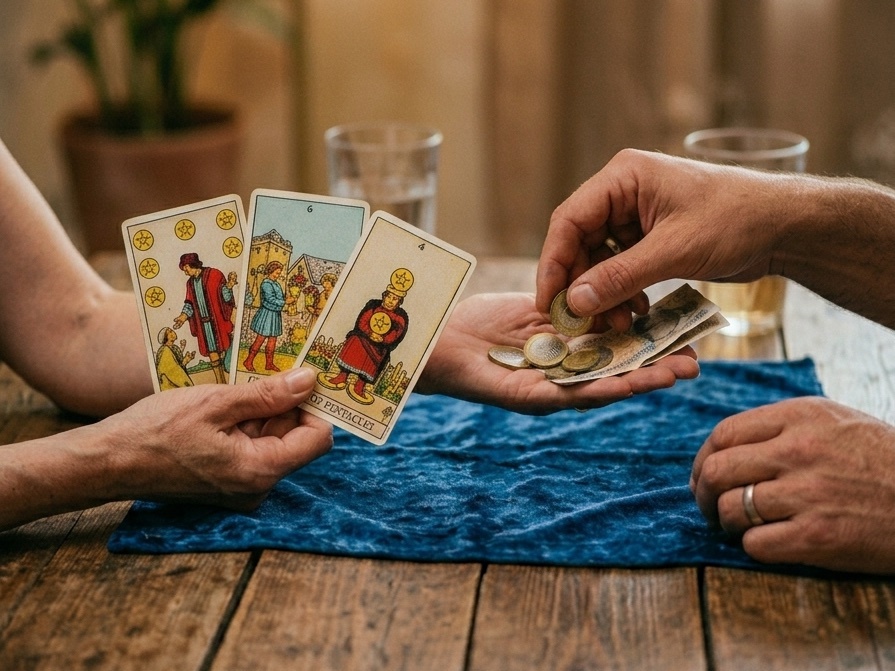
The Reading Is Free. The Donation Is Up to You.
Here’s an awkward question I get asked sometimes: “So how much do you charge?”
The honest answer is: it depends on the context. For friends, family, and coworkers who are curious, I don’t ask for anything — though a few have chosen to donate anyway, which is genuinely touching. For fundraisers and events, I use a suggested donation schedule. You can find those details on the Services page.
The pause that follows is usually a version of: wait, you’re doing this for charity?
Yes. And I’ve come to think that’s not incidental to the model. In fact, it’s kinda the whole point.
Price Tags Mean Something
Here’s something I learned from years of pricing exercises in my marketing career: “free” isn’t neutral. “Free” is a signal. “Free” tells people something has no value… or perhaps that the person offering it believes it’s not worth charging for.
There’s a reason a nice Bordeaux tastes better than Two Buck Chuck — and it’s not entirely about what’s in the glass. Researchers have run experiments exploring how people think the same cheap wine tastes better if they hear it’s from California instead of North Dakota, or if they are told it’s $45 instead of $5. The people legitimately enjoyed the wine more, and would rate the rest of their meal higher. Price and presentation shape our brain’s perception before the first sip.
So if someone asked me for a reading and I said “don’t worry about it,” I’d be signaling, albeit unintentionally, that this isn’t worth much. But for someone approaching tarot for the first time, a suggested donation does something important: it signals that what’s about to happen is real, and worth taking seriously.
The money going to charity doesn’t undermine that. If anything, it reinforces it. You’re not paying me. You’re investing in something that matters, and getting a genuine reading in return.
The Skeptic’s Surcharge
Here’s something I noticed at the very first fundraiser I did, back at the Masquers Halloween event in October 2025: some people thought $5 was too much… and others were surprised I wasn’t charging more.
Both reactions were responses to the same underlying anxiety: what am I actually paying for here, and is it legitimate?
That’s the woo woo tax. Tarot carries enough cultural baggage — mysticism, fortune-telling, hucksters who swindle unsuspecting rubes — that even curious, open-minded people approach it with a little ambient skepticism. When you charge for it, you’re asking someone to hand money to a stranger for something they’re not entirely sure they believe in.
Attach it to a charity, and that calculus changes. The money is going somewhere they already feel good about. The reading may be why they showed up, but the donation is what they’re actually doing. The mental friction dissipates as the transaction cost drops. People who might have hesitated find it easier to say yes.
This isn’t a trick. The charity framing isn’t there to manipulate anyone into a reading they didn’t want. It’s there to remove friction for people who did want one but needed to give themselves permission.
The Four-Way Win
The model I’ve landed on works for everyone involved. That may sound too much like a marketing claim, but it’s based on these observations:
The event organizer (for charity events), gets something unusual and memorable to offer — not another raffle or bake sale, but an experience people will actually talk about afterward.
The seeker gets a real reading in a low-stakes, no-pressure environment. They pay the suggested donation, it goes somewhere worthwhile, and they walk away with something to think about.
The cause gets money it wouldn’t otherwise have, and a little goodwill along with it.
And then there’s me. I very much enjoy these encounters with seekers and appreciate having more opportunities to give readings.
Here’s another place where the charity model earns its keep, in a way I didn’t fully appreciate at first. If I were a tarot professional, with my career depending on repeat business? My seekers would have every reason to wonder, in the back of their mind, whether the reading was calibrated to keep them coming back. Yes, I care about my seekers and I want them to leave feeling good — but “feeling good” should mean the reading was genuinely useful, not that I told them what they wanted to hear. Because the donation goes to the cause either way, there’s no structural reason for me to pull punches. That removes a subtle source of doubt.
That’s a better reading for them. And honestly, a more interesting one for me.
More Than a Sideshow
I said it plainly at that first fundraiser: I do this just for fun. And I meant it, at the time.
But the model has become more deliberate than that. The charity wrapper makes tarot feel like what it actually is, rather than what people assume it is. A practice. A service. A moment of genuine connection between two people — one with a question, one with a deck of cards — to bring about something good.
That turns out to be a pretty great context for a reading. And… it’s one I’m going to be trying out at the end of May by participating in a church fundraiser.
 Tarot for Good
Leave a comment