Deep Roots, Open Branches
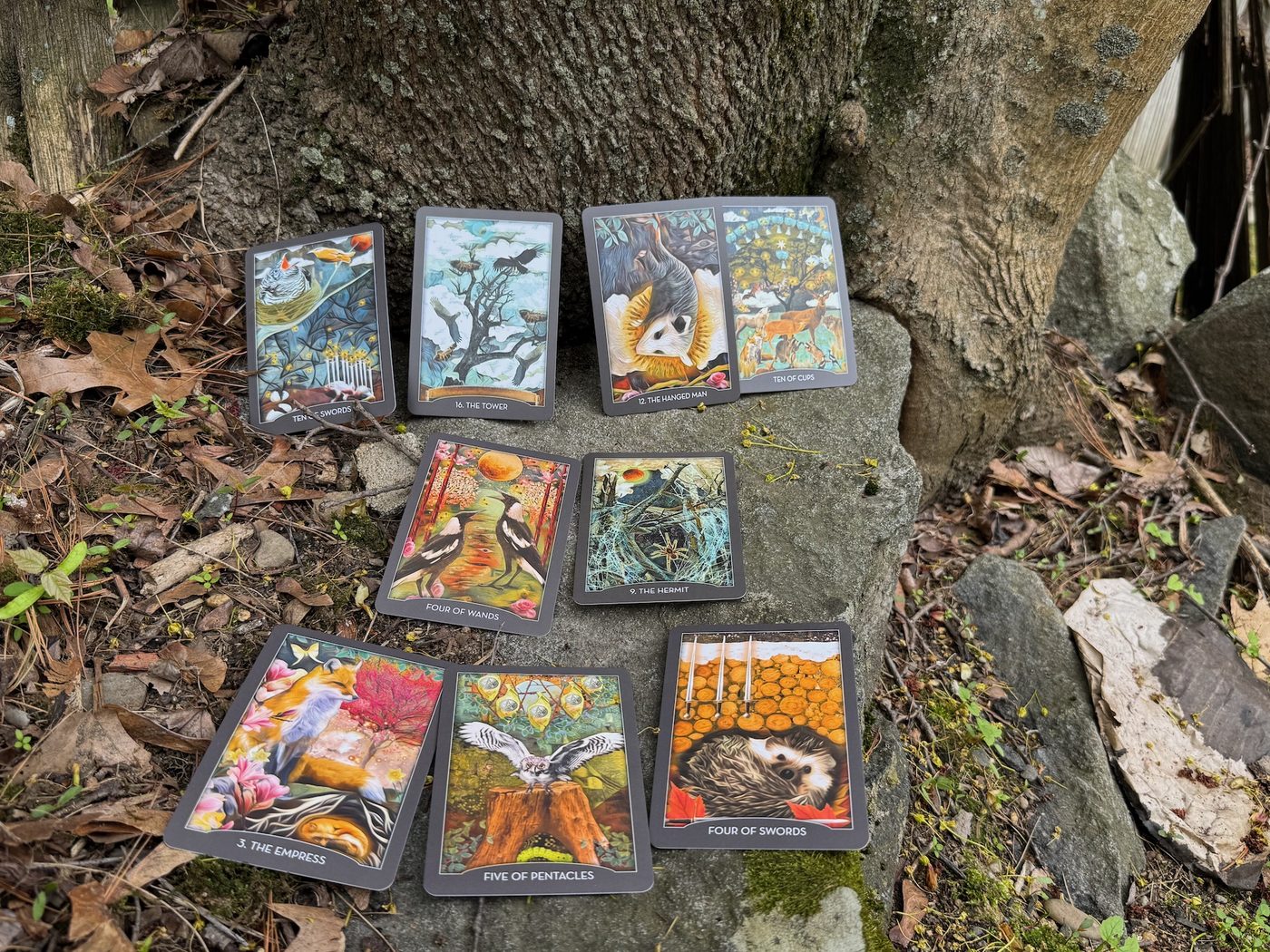
The seeker leans across the table.
"What I really want to know," she muses, "is what I'm supposed to do now."
Empty nest. Open calendar. Time and intention in abundance — but no direction. It's one of the most human questions there is, and it needs exactly the right tool to answer it.
There's a spread for this. There's always a spread for this.
"We're going to do what I call a Roots and Branches reading."
What's a Spread, and Why Does It Matter?
Many tarot readings are built around a spread: a predetermined layout that assigns meaning to each card's position before a single card is dealt. One position might represent your recent past; another, your current frame of mind; a third, the challenge you face. The spread acts as a framework. The cards then flesh it out.
A spread isn't magic, though occasionally it feels like it is. That's because when you assign meaning to positions before you deal, it shapes the interpretation of each card. Instead of a handful of cards floating in free space, you have cards in conversation with each other, each with a job to do.
And because the cards are physically laid out together, they develop spatial relationships. You notice that a figure in one card seems to be looking toward the card beside it — or pointedly looking away. A card representing options might feel tense next to a card representing obstacles, and open next to a different one. The arrangement becomes a story, and the reader's job is to pull that story out.
Most people who have dabbled in tarot have encountered a few standard spreads. The simplest is the three-card pull: past, present, future. Quick. Intuitive. Often recommended for beginning readers, perhaps by the booklet that accompanies many tarot decks. From there, spreads get more elaborate — the most well-known being the Celtic Cross, a ten-card layout that attempts to capture everything at once: your situation, your obstacles, your subconscious, your likely outcome.
The Problem with One-Size-Fits-All
Here's the thing about those spreads: they're designed to work for anyone in any situation, which means they're not optimized for your question.
A past-present-future spread makes sense if time is the organizing principle of your question. But what if it isn't? What if you're not asking what happened and where am I headed — what if you're asking which of these three paths is right for me? Forcing that question into a past-present-future frame is like using a hammer to turn a screw. Technically possible, but not really the point.
This is also what distinguishes a thoughtful in-person reading from simply looking up each card's meaning in a book — or asking an AI chatbot (which are quite good, these days, at regurgitating definitions into a plausible narrative). Any of those can tell you what the Knight of Wands means in isolation. What they're less skilled at is noticing the way that Knight leans into the card on his left and away from the card on his right, and how that ties into the seeker's question. These nuances, these ambiguities, this storytelling by seeing patterns is irreducibly human.
The spreads in the booklet are starting points. What turns a generic tarot reading into a specific, helpful one is a good match between the shape of the spread and the shape of the question.
How the Roots and Branches Spread Works
The Roots and Branches is my adaptation of a concept behind a lesser-known layout called the Ankh spread — named for the ancient Egyptian symbol, which has a vertical stem, a crossbar, and a loop at the top. The Ankh spread uses that geometry deliberately: what sits below the surface represents the past and its causes; what rises above represents manifestation and outcome. When you use it, you're essentially performing a spiritual autopsy on a situation. It's perfect for the seeker who asks, "What's happening to me and how do I decide what's next?"
My version makes that vertical logic more literal and easier to read. The layout looks like a tree.
The Roots sit at the bottom in a horizontal row of three cards. These are the "why" — the background energies, the beliefs and patterns operating underneath the surface, the stuff the seeker might be ignoring or not yet ready to face. If the roots are troubled — say, the Devil showing up, or the Three of Swords — that suggests taking a look at what's feeding the current situation. Healthy branches can't grow from poisoned roots.
The Trunk sits in the middle: a couple cards representing the present moment. The physical reality. The "what." I usually pull two cards here: partly because it looks right, and partly to represent the present having more than one layer. After all, what's on the surface may not match the emotional reality underneath it. We may pull a third card for the trunk if I think the story is incomplete.
The Branches fan out across the top in an arc of three or four cards. These cards represent the natural trajectories that emerge if the current root energy continues. They represent options... pathways... even perspectives. Sometimes a branch card indicates a direction worth pursuing. Other times it may provide a lens for evaluating options, or even flag where not to put your time and effort. I choose three or four branches based on feel: if three tell a complete story, I may stop. If something still feels unresolved, a fourth card often fills the gap.
The whole spread runs eight to ten cards. It reads fast, stays legible, and keeps the seeker's question at the center of every position.
Reading the roots is like being a therapist. Reading the branches is like being a weather forecaster. A good session means I do a bit of both.
The Story the Cards Tell
Here's where it gets interesting... and personal.
In a recent reading I've written about elsewhere, a seeker was asking about where to put their energy going forward. One of the branch cards was the Death card, reversed. Reversed cards represent resistance to the upright meaning — in this case, resistance to necessary change. When we explored it together, the seeker acknowledged that their body was increasingly unable to support a physical activity they'd loved for years. They knew it. They'd known it for a while. That branch card wasn't telling them what to do; it was flagging where not to put their energy. Meanwhile, a card in another branch (the Three of Pentacles) pointed toward collaboration with others to build something that would last, which matched a different project. The branches were providing a useful map of the terrain.
In another reading, the root cards told a story so clearly that the seeker not only acknowledged its resonance, but circled back to explain it to me afterwards. It read that they were coming off a long stretch of bad luck (the Wheel of Fortune reversed) that had shaken their confidence (the Devil), but had gotten through it by finding the right partner( the Two of Cups). That foundation, established in the roots, made the branch cards more meaningful. When the Knight of Wands appeared at the top, representing that same partner riding in with momentum and purpose, it felt more like confirmation than coincidence.
One more example: the soon-to-be empty nester. The trunk cards said everything that needed to be said about where this person was right now: the Page of Cups suggested they'd defined themselves through nurturing for so long that their identity felt like a blank page without it; the Three of Wands reversed pointed to frustration at the horizon feeling so unclear; the Eight of Cups reversed showed someone not quite ready to walk away and close the book on this chapter of their life. The seeker looked at me and said, "Yeah. That's exactly it." The branches did their work from there.
Not every position will be a "hit," but that's okay. We just need enough of the story to land that the seeker feels seen. The branches give them somewhere to go.
The Spread Finds Its Question
The Roots and Branch spread has become my go-to for a particular kind of question. These are questions from seekers who feel caught in a loop, unsure why certain patterns keep repeating, or simply overwhelmed by possibilities without a clear way to evaluate them. It's less about predicting a destination and more about illuminating the terrain.
That's the real reason I keep coming back to it. The branches don't predict; they offer perspectives. The spread grounds the present in the past, and opens the future to genuine options. For a practice that's fundamentally about helping people hear themselves think more clearly, this logic of roots, trunk and branches feels exactly right.
Some seekers come to the table with no idea how to even begin thinking about what's next for them. The right spread can do a lot of the heavy lifting, not by providing answers, but by asking better questions, with room for the cards to talk to each other. If you're curious what that looks like in practice, let's find out together.