The Global API: Jung, Archetypes, and the Tarot Interface
When first introduced to Tarot, most see it as fortune cookies and horoscopes on steroids. (I confess, I was no different.) After all, how can 78 pieces of cardboard have messages any more accurate than mass-printed slips of paper or vague predictions made for 1/12 of the population? But the fascinating thing about Tarot is how it can trigger some profound insights as well as some spooky "hits" when it's eerily accurate. How does it do that?
When we talk about the subconscious in a tarot session, it can sometimes feel a bit black box. We know there is a part of our mind processing things beneath the surface, but how is that information organized?
To understand, it helps to look at the architecture of the human mind, and Carl Jung's Theory of Personality.... no, wait, where are you going? Oh, come on. I swear, this is interesting stuff. And, it's relevant to Tarot.
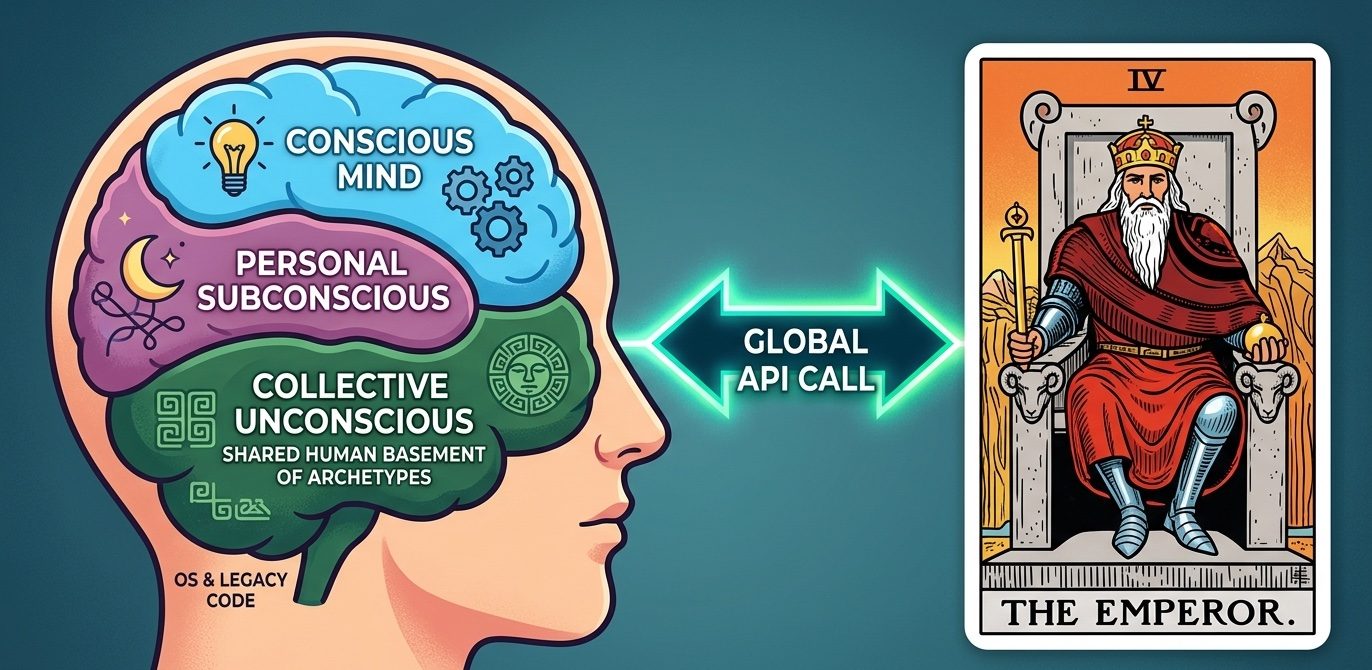
Perhaps you've heard of Sigmund Freud's model of the Id, Ego, and Superego? That power struggle between our basic drives and our internal police officer is but one potential model for the brain. Jung offered a different perspective: a model of the psyche that looks much more like a modern database. Jung postulated that our minds aren't just local storage for our personal memories. He suggested three layers:
- Our Conscious mind, which holds our thoughts, memories, emotions, and overall sense of self.
- Our Personal Unconscious mind, which has memories, feelings, and experiences that we've forgotten (or repressed!) but influence behavior
- A Collective Unconscious, a foundation of shared human experiences (archetypes) that we are all born with, pre-installed.
The Backend Database of our Psyche
Apps typically have a backend database that acts as a foundation for everything the app knows. Think of the Collective Unconscious as our psyche's backend database. It's a massive, shared repository of human patterns that has been "coding" itself for thousands of years. We don't enter the world as a blank slate; we arrive with the legacy code of the human experience already running in the background, waiting to be accessed.
Within this mental database are what Jung called Archetypes. These are universal patterns or themes of people and situations. Every culture, regardless of geography or history, shares several core concepts. The Mother. The Sage. The Trickster. The Hero. They're hard coded into us.
Long before I discovered tarot cards or Carl Jung, I was a fan of the work of Joseph Campbell. His study of the Hero’s Journey resonates with us all. Campbell showed that whether it’s an ancient Greek myth or a modern epic (Star Wars? Lord of the Rings? The Matrix? Harry Potter?), we are often re-telling the same monomyth. We recognize storytelling stages like the "Call to Adventure" (take this lightsaber / ring / pill / wand ) and the "Meeting with the Mentor" (Obi-wan / Gandalf / Morpheus / Dumbledore) because that code is already written into our mental basement. We aren't learning these stories; we're effectively remembering them.
Icons on the Desktop
Permit me to continue the nerdy programming analogy. If the Collective Unconscious is the backend database, then Tarot is basically a Global API. Or, if you prefer, it's the clickable icons on your desktop.
It's difficult to directly access the lower layers of the mind, be it your Personal Unconscious or the Collective Unconscious. Down below your consciousness is a swirl of raw data, instincts, and shadows. In that sense, a Tarot deck acts like the icons on your computer desktop. When you see "The Emperor," you aren't just looking at a drawing of a man on a throne. You are clicking the "Authority/Structure" icon. Your brain instantly makes a call through this Global API and pulls down everything you know about order, boundaries, and leadership from your database of archetypes.
When we lay out a spread of cards, we are essentially running a query on your current situation. We are looking to see which universal patterns are active in your life right now. Are you currently in a "Hero’s Journey" phase of struggle? Is there a "Shadow" element you are ignoring? Your Personal Subconscious may have something to say as well. Your Personal Subconscious communicates to your conscious self primarily by sending messages through dreams. A tarot card reading can provide another way for your subconscious to get in touch with your ego as the cards trigger reactions from your emotional baggage and psychological stresses.
Why the Code Matters
This Jungian model is the foundation of a secular tarot practice. It removes the need for "magic" and replaces it with evolutionary pattern recognition.
A tarot session is a way to "ping" the server. It allows us to step out of our local cache—our daily worries and loops of logic—and see how our situation fits into the broader human narrative. It’s a tool for debugging your current path by comparing it to the universal "master code" we all share.
By using these archetypal icons, we can skip the small talk and get straight to the architecture of the problem. You aren't just guessing at your future; you are reviewing the shared human blueprints to see where you want to build next.