The Skeleton in the Room
There is a scene in the 1973 James Bond film Live and Let Die where the villain's personal tarot reader ("Solitaire") is asked if she foresees Death in the cards. (She draws the Lovers instead: predicting Bond was on his way.) It's a small moment, but it captures how tarot cards are perceived from popular culture: the Death card is shorthand for doom (as shown later in the movie). It's the scary one. The one that makes people gasp at parties.
Let me disabuse you of that notion.
The Death Card's Real Job
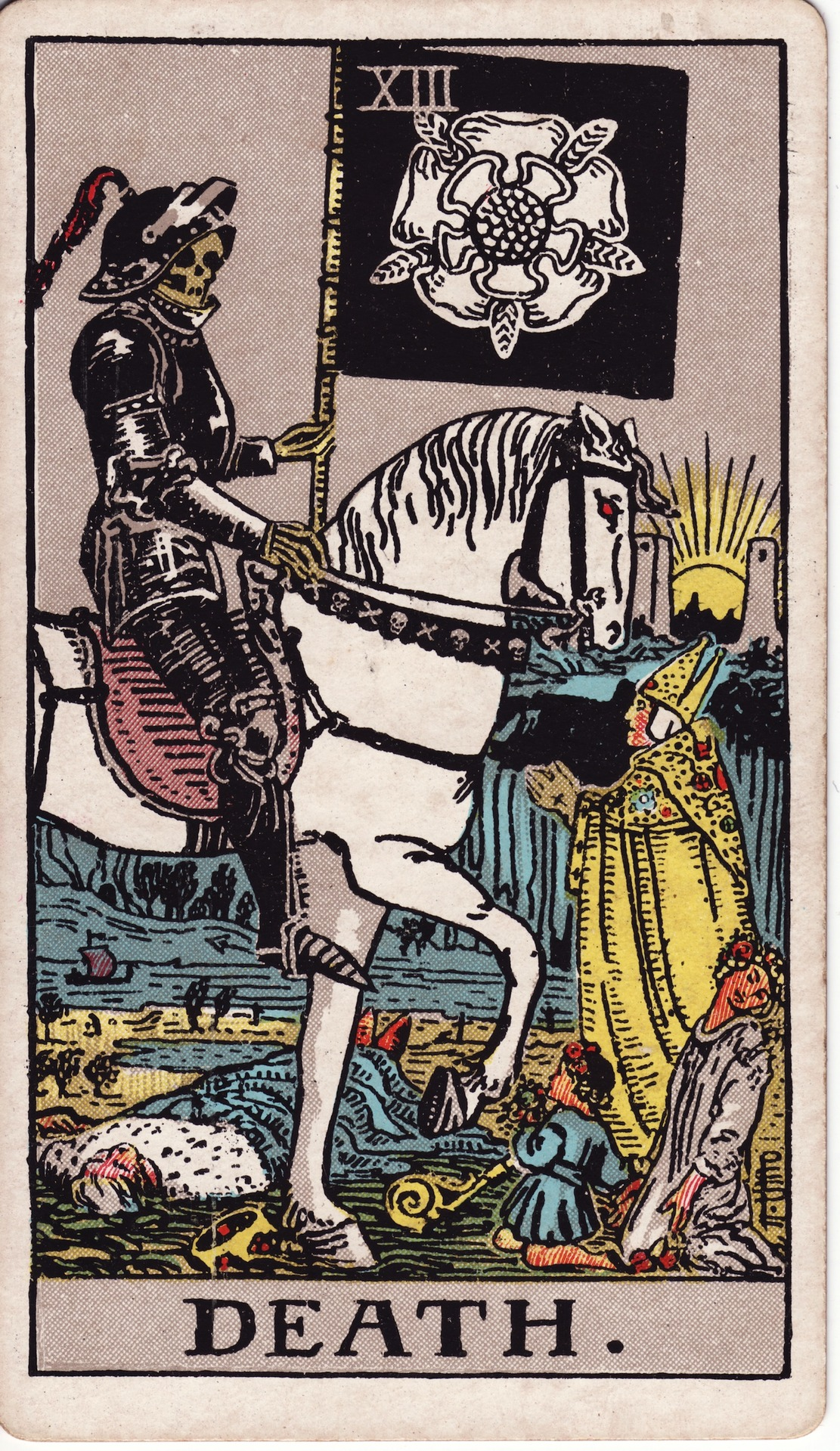
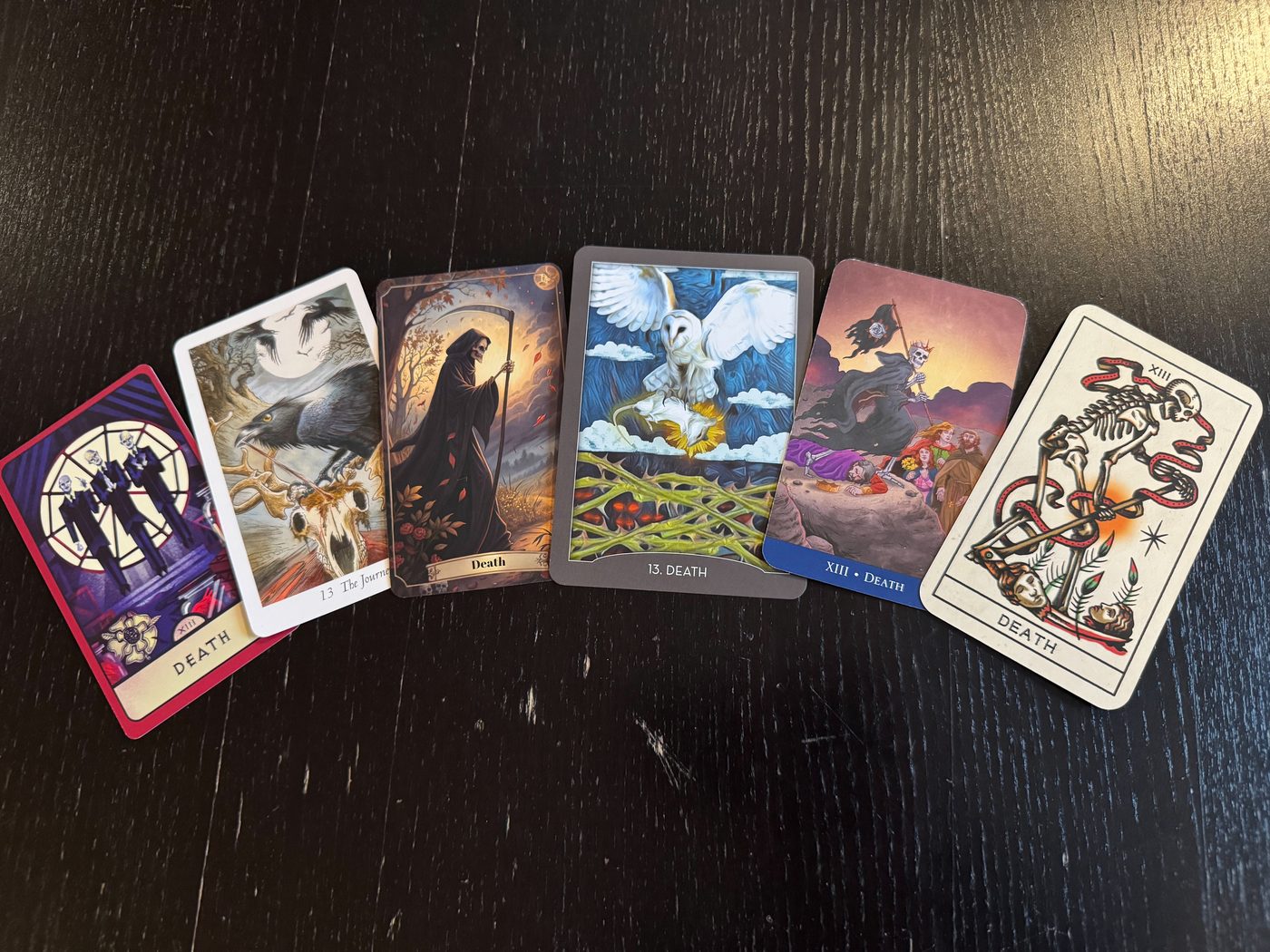
In a tarot deck, Death is lucky number 13 of the Major Arcana. Whether the classic Rider-Waite image of a skeleton on horseback, or other variations such as the ones I've shared above from my collection of tarot decks, the dramatic depiction of a skull-faced harbinger is understandably unsettling. And yet, the Death card is not a prediction of literal mortality. It is an archetype — and like all archetypes in the tarot, its power is symbolic, not prophetic.
Death represents change and transition. More specifically, it's the slow, deliberate movement from one state to another. It's an inexorable shift, like the seasons changing or a chapter ending. It's the version of yourself you're quietly outgrowing. Contrasted with the tarot's card for sudden, jarring upheaval (the Tower), Death is quieter and perhaps more profound. It's the recognition that something has run its course.
The distinction matters. When the Death card comes up in a reading, the impulse is to brace for catastrophe. Instead, it provides an opportunity to be asking: what is ready to change in my life, and am I willing to let it?
Aging Out
I want to offer a new favorite phrase that I think captures this archetype better than any spooky Grim Reaper imagery: aging out.
While the term is often used to refer to a young person leaving foster care or no longer qualifying for youth services, I was introduced to it from the competitive marching band world. Organizations like Drum Corps International have a hard age cutoff — once you turn 21, you are no longer eligible to march competitively. You age out. It's an emotional and bittersweet cultural milestone, celebrated and mourned through long-standing traditions. While members can still come back as instructors, technicians, or fans, that form of participation is finished.
My father recently described a similar experience with his home brewing hobby. He spent over a decade making his own beer. Beyond the initial investments in equipment and skill, it also required time, physical energy, and, obviously, the ability to enjoy the results. Now, between changing health and a schedule that no longer cooperates, that chapter is closing. But he didn't quit in defeat. He recognized, honestly, that the circumstances had shifted enough that continuing didn't make sense anymore. He aged out.
Recently while giving someone a reading, we pulled the Death card (reversed) for a question about where to put their energy. When we explored what that meant, they shared that their body was increasingly unable to support an annual physical activity they had loved for years. Deep down, they knew it. They had known it for a while. But they still weren't ready to give it up yet. A reversed card symbolizes resistance or opposition to the upright message, so that was Death's subconscious message here: you know something needs to change, and you are not ready to admit it yet.
This is the important nuance in aging out. It is not purely passive. Yes, external circumstances shift — health changes, bodies change, rules change, time runs out. The constraints are real. But the agency lives in how we respond to them. Do we acknowledge what has changed? Or do we pretend the door isn't closing and keep pushing against it?
Sure, it's possible to use "aging out" as a convenient euphemism that dodges responsibility for the decision, and try to play the victim of those circumstances. "I had to stop." "It wasn't working anymore." Maybe that's true... or maybe it's a way of avoiding the harder, more honest sentence: "I chose to stop, because I recognized what had changed."
That distinction — between being acted upon and acting — is a critical nuance when it comes to the Death card, and tarot in general.
Leaving When It's Your Choice
The tendency to linger longer than you should in a beloved activity is as human as it gets. We don't like change, especially when it's change from something comfortable. Casinos know how hard it is to walk away from the table when you're winning... and even harder when you're losing but think you can win it back. Athletes and other competitors almost never leave on top; think of how many great players stayed a season too long, chasing a sport that is passing them by. For most, the game ends them before they can retire gracefully.
Some competitors pull it off, like Barry Sanders, Ashley Barty, or Bobby Fischer. And for some, leaving on their terms is the break they needed to return. Michael Jordan's retirement and subsequent return to win three more championships. Alysa Liu, who left figure skating in 2022 but then came back on her terms and won gold in 2026. That arc — letting something die so it can be reborn differently — maps directly onto the tarot story of the Fool's Journey, the narrative arc underlying the Major Arcana. Death is the middle of the story, not the end. Judgment (card 20) comes later, and with it, rebirth.
That's why the Death card can be one of the most hopeful cards to come up in a reading. It asks you to look for something genuinely ready to end. Endings make space for growth and transformation.
When I Pulled Death Myself
That idea of Death as a hopeful card was already rattling around in my head one morning when I sat down for one of my own single-card journaling pulls. The reflection prompt: How do I know when it's time to move on from a cycle or role that has run its course?
I pulled Death. I legit laughed.
I had just spent the evening before with friends talking through the aging-out concept. We wrestled with whether it represented a loss of agency or an act of it. Ultimately this card and question hints at an answer: the two aren't mutually exclusive. Circumstances change. Our responsibility is to notice, then decide what to do about it.
We all have so many examples of this in our lives: a job, a physical activity, a team or club. What do you do when the group you belong to stops being the group you joined? When leadership changes... when the people you came for have moved on... when the mission drifts and what you loved about it starts to feel like a memory. Do you stay out of loyalty to what was? Do you let inertia make the decision for you? Or do you acknowledge that the version of the group that meant something to you has, in a real sense, already ended?
These questions don't have clean answers. I'm sitting with a few myself right now. But the Death card isn't asking you to decide immediately. It's asking you to stop pretending the question isn't there.
The Payoff: You Hold the Pen
The Death card is not a fortune teller sealing your fate with the flip of a card. It is an opportunity, not a verdict.
Tarot cards act well as mirrors. The Death card reflects back the transitions already happening in your life. You already know them... the situations you're half-acknowledging, sidestepping, and dressing up in softer language so you don't have to face them directly.
When Death appears in a reading, the question isn't "what terrible thing is about to happen?" The question is: "what chapter is already closing, and am I walking through that door with my eyes open? Or am I standing in the doorway, refusing to move?"
Bond didn't let that fortune teller decide his fate — he just rigged the deck. You don't need to rig anything. You just have to be honest about the cards already in your hand.
That, in the end, is what the Death card is really asking.