Pre-setting the Table
"Wow. This is, uh… this is impressive."
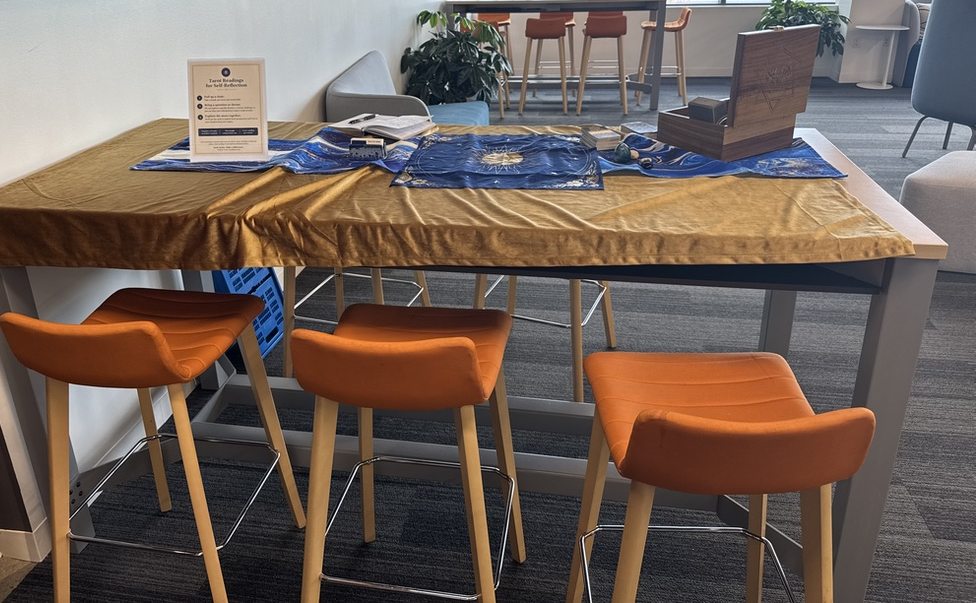
There's a moment, somewhere between my spread cloth going down and when I fan the chosen deck of tarot cards out, when a seeker's eyes widen a little. I'm never sure exactly what they were expecting, but the shift in attitude is quite noticeable. Maybe they expected me to just nonchalantly flip over a few cards, or maybe they expected me to go all hocus-pocus and spirit finger-y. Instead, what they see is a tableau of colorful cloths and stones alongside an impressive wooden box, all laid out before them on purpose to set the scene. I read their look as a quick recalibration: hmmm, this guy is serious.
It's a moment I'm engineering on purpose, but at the same time, there's nothing magical about what I've laid out. The paraphernalia is just another vehicle to transport the seeker from wherever we are – a conference room, a fairground, the corner of a church – to a place more conducive to tarot reading. I give them a chance to take a breath and find a mental state more receptive to whatever message their brain wants to deliver. It's "venue appropriate" for Tarot.
Nobody Orders a Bud Light from the Sommelier
You already know how this works. You lower your voice in a library or a church before anyone asks you to… but you'll hoot and holler with the crowd at a sporting event. You skip the Bud Light at the fancy restaurant with the sommelier, and likewise, you aren't asking for a wine list at the dive bar. We all pick up some combination of convention and social pressure and tend to behave appropriately given the venue.
It also works in the other direction; not providing cues at a venue gives visitors more latitude in their behavior. I saw that effect play out once at a workplace fundraiser where I set up my table. The year before, the event had balloons, streamers, and tables full of baked goods for sale, and it felt like a community celebration. But the year I read there, the event had lost its organizer a few weeks out, and with her went the enthusiasm and the long list of volunteer bakers. The time and effort didn't get put in to make the event feel like a special occasion. The purpose hadn't changed, but the setting had… so my coworkers' mindsets slipped from "let's come together for this cause" to "hey, look, I can get a slice of homemade cake for five bucks."
Why the Tablecloths Come With Me
My table is a deliberate attempt at creating a space suitable for reflection – I hesitate to call it "sacred," but that's certainly the sense I'm trying to convey. I lay down a royal blue spread cloth, atop a gold tablecloth with a colorful runner. I bring out my small collection of crystals and stones and scatter them around. I pull my card decks out of a wooden box with a seven-pointed star etched into its lid. Candles (real or electric) can also set the mood so the table says this is more than some schmoe dealing out cards.
The stones have a second job that has nothing to do with the seeker, and nothing to do with explanations like "bumblebee jaspers are good for creativity" or "lapis lazuli provides wisdom and psychic protection." (I both roll my eyes at these descriptions and fleetingly want them to be true.) They originate from local shops in St. Pete Beach and Door County, Wisconsin (two favorite family vacation spots), or from a campsite in Pomfret, Connecticut (home of the annual Otherworld event I help staff). When I'm next out at Tanglewood to sing, I'll find something from there as well. All of those venues are ones I strongly associate with people and activities I love. They recharge me and bring me back to myself. In fact, when I do readings for myself, I make sure to put them out there as a reminder of who I am, where I've been, and what I love.
For a longer reading session, I'd encourage a seeker to bring a few things of their own for the same reason: a reminder of who they are and where they come from. Bringing something personal makes the session theirs, and that builds receptivity for the reading. It's a great brain hack.
Hacking Your Brain's Expectations
The research on "hacking your brain" by setting it up for success or failure goes well beyond tarot readings. In a well-known 2008 brain-scan study, people tasting the same wine rated it as more pleasant, and showed more activity in a pleasure-related region of the brain, when they were told it cost more.
In one of my favorite books, Pre-Suasion by Robert Cialdini, the author builds the case for how channeling a brain's attention leads to priming it for different outcomes and decisions. A simple example: A group of people asked if they were unhappy with their social lives were 375% more likely to declare themselves unhappy compared to those asked if they were happy with their social lives. The examples get weirder and weirder, from people more likely to choose German wine over French wine if German music is playing over the store speakers, to shoppers agreeing to try an untested product if you first ask them if they consider themselves adventurous.
What we see first sets the frame for everything that follows, and that frame works on you as well as on your audience. I get dressed for work even on days when no camera is on, because the clothes put me in the right mindset before the first meeting starts. The same logic shapes how other people see us. An engineer in a tie can lose a little credibility, while one in jeans and a t-shirt gains some, and for a salesperson or a marketer the opposite is true. I've worked on both sides of that line, and the "rule" is the same: dress for the role and the venue.
Done well, this conscious table-setting can lead to some seemingly magical moments in a tarot reading because the conscious brain is primed, receptive, and quiet enough to listen to what the subconscious is screaming about. The tablecloths and stones don't change what cards appear. However, by pre-setting the table, I make it more likely that Tarot, as a tool for guided reflection, will do its job. I don't own hoop earrings or a crystal ball, but I understand the instinct behind them. The classic fortune-teller look is an old and very effective way of setting the scene.
I don't consider this deception, any more than laying out place cards at a fancy dinner or having guests walk onto a cruise ship with the crew lined up applauding them is deception. In another favorite book of mine, The Art of Gathering by Priya Parker, she emphasizes how critical it is to intentionally consider what guests see and experience when they enter a communal space, as that shapes the rest of the gathering. Similarly, seekers who walk into a serious setup bring a serious frame with them, and they adjust their expectations and better honor the whole process instead of half-shrugging and demanding to hear their future.
Set Yourself Up to Be Present
The cloths, the runner, the box, and the stones – they're all small things, but each one tells a seeker that what comes next deserves attention. The research suggests the brain takes that cue and runs with it. A quiet library, a good wine list, and a work shirt do the same job for their venues. You can even prime yourself by choosing cues on purpose: your clothes, a smell, your background music, maybe a souvenir on a shelf just within your field of vision. That way you shape your reality instead of merely accepting whatever your environment happens to supply.
That's why I set the table before a reading: it prepares both me and the seeker to be present for what the cards bring up. The next time you sit down for some you-time, be it a tarot reading, a few minutes of meditation, or a serious think about something that matters, ask what you could change to put yourself in a reflective mood. It might be a quiet corner, a candle lit on the table, or a stone from your favorite vacation spot in your pocket. And if you'd like some help getting there, I'll have the table set for you.