Flight Simulator for a Tarot Table
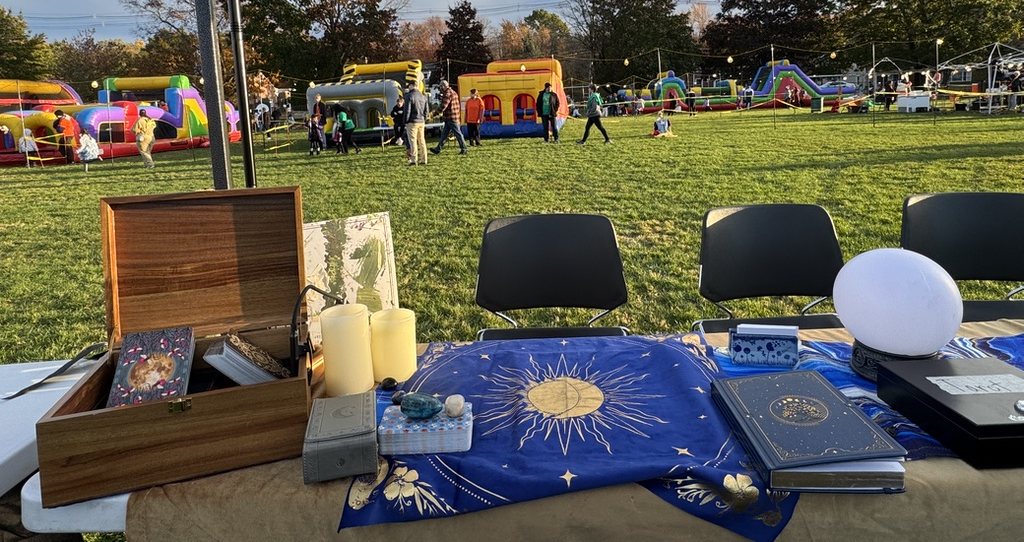
A few days before an appearance doing tarot readings at two fundraisers, I got some additional readings under my belt. I read for a man in his 40s managing people who used to be his peers. Then I read for a woman in her early 30s weighing a grad program on the opposite coast from her partner. Shortly afterward, I read for a mother ruminating a week after dropping her last kid off at college, not sure who she's supposed to be now.
Good sessions, all three. Real tension in the cards, real follow-up questions, real moments where I had to sit and think about how to interpret a hard card instead of glossing over it.
Except none of those people were real.
Let's Get the Controversy Out of the Way
AI for tarot reading: it’s a fraught topic, and I know exactly who's bristling right now. The Venn diagram overlap of “people who are into tarot cards” and “people who hate AI” is close to a full circle. It’s not surprising that a practice often associated with witchy inner-space nature-first earthiness would have practitioners who feel AI is some combination of an environmental catastrophe and an engine for making us all dumber. And, lest we all forget, frontier LLMs have been created by companies run by billionaires who shouldn't be trusted with a toaster, let alone the future of humanity. I’ve heard these AI vegans and vegetarians in person, on Reddit forums, and elsewhere across the internet, telling me why they don’t use AI and why I shouldn’t either. Frankly, a lot of their concerns are legitimate. I'm not going to litigate them here; that's a different post. (Maybe one I'll never write.) That said, I want to acknowledge the objections to mixing AI with anything, let alone Tarot, before I tell you what I've been doing.
What I will agree on: the version of "AI and tarot" that deserves side-eye is the one where you draw a few cards, type them into a chatbot, and get back a competent, by-the-book reading. It represents the denotative card meanings, it puts together a narrative stitching them together, maybe it even gives you a clean reflection question at the end. I've done this myself, and it’s impressive on the surface. Early on, it was even useful as a way to drill myself on card meanings I hadn't internalized yet – call it a flashcard deck that talked back. But as a regular practice? I’d unmistakably characterize chatbot tarot as tarot readings but with the whole point of Tarot surgically removed.
Across the Table, Not Across a Prompt
The thing a chatbot reading can't do is sit across from someone while they’re turning a water bottle over in their hands, deciding how much of the truth to say out loud. It can't catch the half-second pause before someone admits the job they got isn't making them happy. It can't adjust because it saw someone flinch when the Tower came up. The read itself, cards and meanings, is just one part of what happens at my table. The rest is a conversation with a functioning nervous system on the other side: a person with all their triumphs, warts, questions, and humanity trying to find their way through like all the rest of us. That's the part of Tarot I'd never want to automate. It's what makes the whole exercise worth my time with a stranger as well as worth their time to listen to me.
So if the table is the point, where does AI fit at all? The answer: in the rehearsal.
Not Enough Flight Hours
The problem with live readings is that there simply aren’t enough of them to get comfortable with reading. A good festival might get me ten or twelve readings from walk-up strangers in an afternoon, if I’m lucky. In those five to ten minutes each, there’s no time to think out loud, look up a card meaning, or ponder what an unseen card combo might mean. It’s a small sample size to build real instinct on, and every one of them happens with an actual person watching you stare at your spread trying to remember what the Nine of Pentacles means. (A three-card deal of a 78-card tarot deck, including card reversals, works out to over 3.6 million possible card arrangements… I won’t see them all, but as I get more reps in, I start to recognize patterns.)
Plenty of professions solve this exact problem with logged hours before you're allowed to do the real thing solo. The FAA requires 40 hours of flight time before you can get a private pilot's license, and that's before you're trusted with passengers. Therapists log supervised clinical hours before full licensure. Electricians apprentice for years before anyone hands them a live panel unsupervised. Heck, even cadets at Starfleet Academy run bridge simulations before anyone trusts them with a real crisis at warp nine.
I don't know of a virtual flight school for tarot readers. Some tarot books suggest practicing readings on celebrities or book characters for practice, though you can only imagine what questions they’d ask and how they’d react. There are online forums where you can exchange readings or compare notes with others, but that’s still pretty slow. So… I made a virtual flight simulator for practicing tarot readings using my Claude subscription.
What I've got now is a practice skill that I can use on dog walks, on commutes, or even as I’m winding down before bed. You can see the /tarot-practice skill on GitHub if you're interested.
This skill asks the LLM to generate a hypothetical person with a believable situation and a question they want answered, then gives me a random three-card draw. I can ask questions and it role-plays how that person might respond. I then give my verbal reading and it then plays the role of a coach: complimenting me on what I did well, pointing out what I might have missed, and offering advice on how to improve based on the areas I’ve asked it to help me work on. It's not a real seeker. But it's enough resistance to build the muscle that matters: asking a clarifying question before I assume anything, sitting with a hard card instead of rushing past it, and building my closing reflection so that it’s truly a question and not a summary wearing a question mark.
What the Reps Actually Look Like
Here are a few examples of how these practice sessions unfold. The simulator started with this:
The scenario: a man in his 40s stops at my table with a cider in hand. Three months earlier he said yes to a promotion that put him in charge of managing his former peers. He tells me he dreads Monday mornings even though it's the job he asked for. His question: why do I feel so stuck when I got exactly what I wanted?
I asked a clarifying question first: "When you are managing former peers after a promotion, the relationship changes very subtly, but also very overtly. Do you feel that you have a good relationship with these peers, or do you feel like it is strained after the promotion?" The AI answered on his behalf: most of the guys were fine, but one, a former regular lunch friend, had gone cold. He thought that guy wanted the job.
The cards were the Six of Swords, the Hermit reversed, and the Three of Pentacles. I read the Six of Swords as an ongoing state of transition: he’s three months into the new position but that’s still mid-journey. It’s a journey that can take longer with former peers than it would with strangers. I read the Hermit reversed and the Three of Pentacles together – about not retreating in his new leadership role but coming back down the mountain, sharing the wisdom instead of hoarding it, seeking to collaborate and build something with the people rather than over them.
Afterward, I received my coaching tips: I moved too quickly from naming his transition straight into a fix without exploring his dread about what it costs him to feel stuck on a Monday morning. And my reflection question tried to do two jobs at once, summarizing the read and asking something new in the same breath, when it needed to be just one tight question. The coach’s suggestion – What’s one way you could show up as a peer, not just a boss, this Monday? – was a tighter version of my clumsier “ask yourself, what can I do to help fulfill this transition by bringing myself to be as present as possible to do good work with my former peers?” That's why I’ve asked the coach specifically to focus on these muscles. I’m getting better at the clarifying questions – probably the engineer in me wanting to pin down the facts before building anything on top of them. I’m still hit or miss on the reflection questions, and that’s what I’m focusing on.
Another example:
A woman in her early 30s sits down, still in her running clothes from a 5k she did that morning. She mentions she’s been offered a spot in a very competitive graduate program on the opposite coast, but her partner’s entire career and family are rooted right where they are. She’s asking: “How do I know if I’m being brave or just selfish?” Your three cards are: The Chariot, Four of Cups (reversed), and Ten of Swords.
I was able to ask a couple of questions to pry at this character’s motivations, before ‘solving the puzzle’ with a reading about how it might not be either-or on “brave or selfish,” that her ambition (The Chariot) and quest to escape boredom (Four of Cups reversed) were what drove her to take this program, but that it would come at great cost (Ten of Swords). Afterward, my virtual coach praised my reflection question (“What’s the one thing you would need from this job to be worth the cost?”) but pointed out I sugarcoated the meaning of the Ten of Swords, which often is read to mean total collapse rather than just a toll you pay. Point taken.
In all, for three days across getting ready for bed, running to the grocery store, and walking the dog, I got in nine practice reads with coaching commentary. If you’d like to read them all yourself – the woodworker in her late 30s contemplating taking over her late father’s workshop space, the man in his early 40s devastated when his best friend since childhood moved away, and the woman in her 50s whose adult daughter moved back home after a breakup – here's the whole transcript.
More Flights Before Takeoff
I fired up these practice sessions because of two fundraisers on my calendar. The first is my second appearance at the Haunted Playground for the North Reading Masquers, since its 2025 event first inspired me. The second is a breast cancer fundraiser at my own workplace, offering $5 to $10 readings, except this time the people across the table are coworkers, not strangers. That one raises the stakes in a way a festival booth doesn't. I'd like to not look like I'm fumbling through a card narrative in front of people I'll see in a meeting on Monday.
That's really what the simulator is for. It’s not to replace the real seekers – never that! It helps ensure that when a real person sits down and tells me something true, I'm ready to actually hear it, instead of madly hunting my memory for the best way to tie the Three of Swords to The Sun reversed.