When I decided to transition from reading tarot as a personal hobby to offering sessions for others, I knew I needed to level up my process. Part of that evolution involved a simple physical purchase: a royal blue notebook with gold trim that matched the tablecloth I use for my readings.
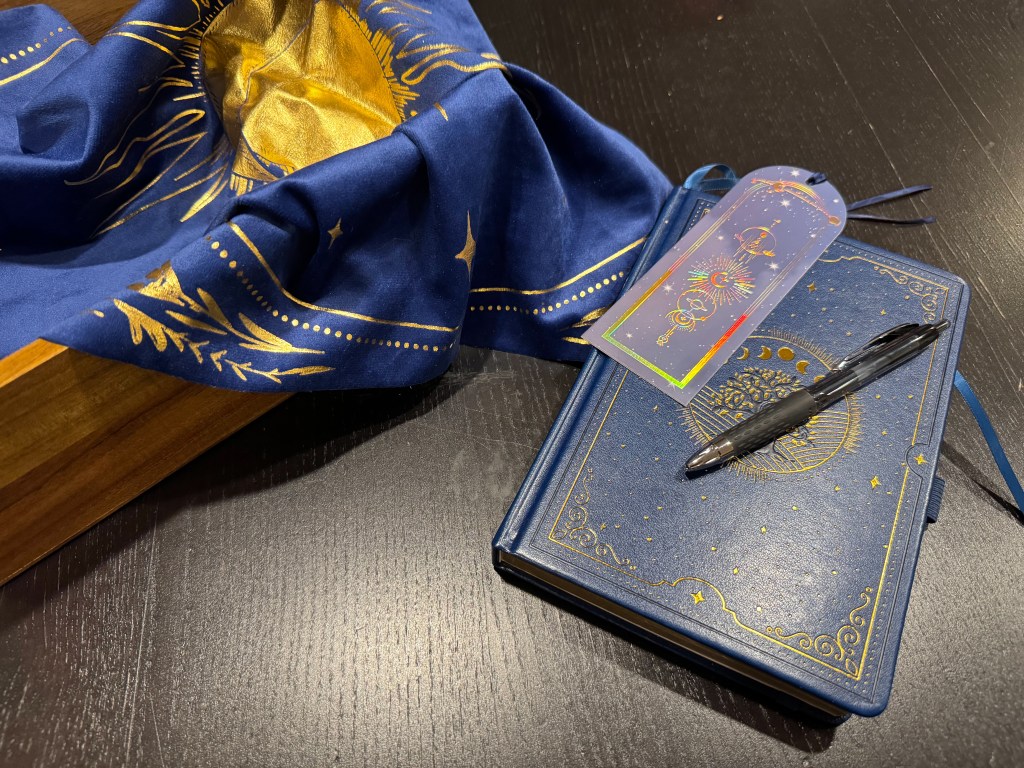
Yes, yes, it makes for a nice prop, but that’s not why I bought it. I realized that if I was going to treat these sessions with the respect they deserve, I couldn’t just rely on my memory. I needed a record.
Out-Nerded in High School
To understand why, set the way-way-back machine to high school. Being the resident nerdy, analytically minded honor student I was, of course I joined our school’s chess club. Besides meeting Thursdays after school for casual games with other members, we’d periodically enter local tournaments. I would sit at the top board during competitions, meaning I faced the best player from every opposing team.
I was regularly smoked.
The difference wasn’t just raw talent. I was playing vibe-chess. I relied on my intuition, my remembered experience, and whatever patterns I noticed in the moment. My opponents, however, always had a logbook. They used formal notation to capture every single move of the game.
At the time, I felt sheepish that I didn’t have one. I realized they were putting in work that I wasn’t. They had studied opening moves and common situations. They weren’t playing by feel; they were going home and studying their past experiences, identifying mistakes, and finding patterns that led to better outcomes. They were treating the match as a serious discipline, while I was just in it for funsies.
I decided I didn’t want to make that same mistake with Tarot.
A Permanent Record for the Subconscious
Your doctors keep medical charts to track your history, notice trends over time, and ensure that the advice they give today is consistent with what happened six months ago. Scientists capture observations in lab books. Marketers look at data from trials to make more informed decisions. Why not do the same for Tarot?
Personally, I was already doing this by journaling my daily pulls and recording larger spreads for bigger questions. The value of a journal lies in both expressing your thoughts and being able to refer to them later. I found that the act of writing everything down made these moments feel more important and permanent, rather than just a casual check-in. I wanted to convey that same gravitas in my readings for others.
A tarot logbook means I can look back and see the “moves” made in previous sessions. If a seeker returns for a second reading, we aren’t starting from zero. We can refer back to our previous discussion and see how the situation has evolved.
Human memory is selective, but a logbook is objective. By recording readings, I can see when certain archetypes are recurring and how they affect the narrative. For example, the Devil card once appeared in a similar context across three out of four successive sessions. By having those entries side-by-side, I could analyze how my interpretation shifted to fit each seeker’s specific questions while still acknowledging the core pattern.
Those other records, though, might be shared among doctors, scientists, or other chess enthusiasts to plumb for insights. These notes are for my study only. It’s a tool for better service, not a collection of gossip. Keeping these recordes confidential is part of my commitment to providing a safe, professional environment for self-reflection.
A Living Study
The notebook component makes every session more meaningful. It transforms a reading from a one-off performance into a living study. There’s something about the ritual—the pomp and circumstance of a reading—that takes it a step beyond just shuffling and dealing out pretty cards. Just as being told you’re drinking better wine affects your experience, the tablecloth and notebook can serve as a signal to a seeker’s brain to level up the experience.
The notebook also serves as a reminder to me that learning about Tarot, just like learning about oneself, is never complete. By constantly reviewing my work, I can provide the clearest possible mirror for a seeker’s thoughts.
When we sit down together, you can expect to see me reach for that blue and gold book at the end of our time. I’m not just jotting down cards; I’m recording components the narrative we built together so that it isn’t lost to the vibe of the moment.
The next time you book a session, know that our conversation will be handled with the rigor it deserves. We are doing the work, and I am keeping the notes.

 Tarot for Good
Leave a comment