Recently, I’ve had people seeking a reading who had the same basic questions before we even began the session: So… what do I do? Do I tell you my question out loud? How does this actually work? For many, the only exposure to tarot is via tropes of crystal balls and dark velvet curtains.
If you are one of those Seekers, let me demystify the mechanics of a session so you can worry less about the logistics and be more prepared to receive insights from a well-structured conversation. I’ll break down into five steps:
- Creating a Focused Space
- Framing the Question
- Choosing the Spread and the Cards
- Interpreting the Story
- Reflecting on the Takeaways
The Environment: Creating a Focused Space
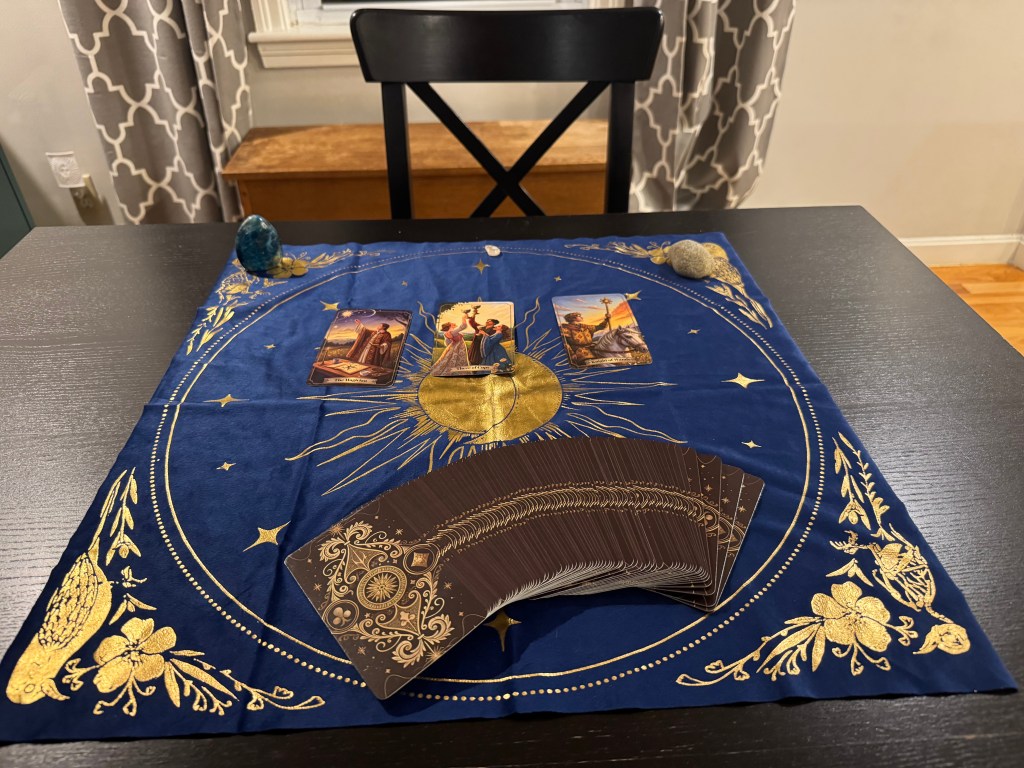
The session always begins by clearing a physical and mental space. While I’m not a crystal ball or heavy incense guy, I do believe in marking the area for the reading to send a deliberate signal to your brain that we’re stepping out of the ordinary. For instance, I like to set a boundary for the cards by spreading out a colorful tablecloth. Just as I do when performing serious readings for myself, I may put out a souvenir from a family vacation or a rock from a 4-H campsite I visit annually. You are welcome to contribute by adding a favorite candle or a personal touchstone to the tableau.
These physical signals help settle your mental focus. This exercise doesn’t work as well if you’re running between appointments or trying to get dinner ready; we want a quiet pocket of time to go plumbing the depths of your subconsciousness. Whether we are in a private room or at a small table in a busy festival, we are creating a temporary bubble where the outside world can wait.
Because these readings require such focus and can hit personal topics, it’s often better to do them one-on-one. That way you’re not distracted or inhibited by an audience. That said, the presence of a trusted loved one who knows you well may actually help the process.
The Consultation: Framing the Question
Once we’ve settled into the space, the most important part of the session begins: determining the question.
A common misconception is that I’m a mind reader and that you shouldn’t tell me too much, as if to test me or the cards. In reality, keeping your thoughts hidden only denies you insight. The more you share, the sharper the mirror becomes. This isn’t a performance where I guess your secrets; it’s a dialogue. We usually start with a simple, honest conversation—the kind humans don’t have often enough—where we drop our barriers and give nontrivial answers to a question like, “How are you doing?”
It may also be tempting to just ask for a general reading, to say you’re open to whatever the Universe wants to tell you. However, a broad, unbounded topic makes finding answers less effective. By honing the inquiry, we can better frame the discussion and get a more meaningful interpretation of the cards.
As we talk, the initial question often shifts. You might start with a general inquiry about your career, but we may uncover a deeper issue. Perhaps it’s a choice you’re considering… or an area where you’re feeling stuck and want ideas. Maybe you’re seeking self-improvement, or validation, or a better connection with a family member. I will steer you away from yes/no, predictive, or prescriptive questions. For example, “Will I get this job?” might become “What can I do to better prepare myself for my next career step?” Or “What should I do with my life now?” might be better reformulated as “How can I best use my extra time now that my kids are grown and out of the house?” These revised questions keep the reading open to advice you can actually use. After all, I’m not here to predict the future or tell you what to do. You’re the one driving your life. I just help you see the dashboard more clearly.
The Layout: Choosing the Spread and the Cards
Once we have a question, I decide how many cards to draw and how to lay them out. In tarot parlance, this is known as the “spread.” Each card turned over is targeted toward answering a specific element of your question.
The number of cards and the spread chosen are factors of our allotted time and the complexity of your question. At a festival booth, a three-card snapshot is often perfect. In a longer private session, we might use a more comprehensive layout like the seven-card “Horseshoe” or the traditional ten-card “Celtic Cross.” If you’re facing an either-or decision, we may pull cards to examine both sides. Occasionally, I may even make up a spread on the fly, laying cards out like panels in a comic book to see how they interact with each other.
When it comes to selecting the cards, I like to give you a sense of agency. If we are meeting in person, I may fan the deck and ask you to choose the cards yourself to establish a direct connection. If we are meeting virtually, you’ll have to rely on my hands, but my focus remains on your question. Does it make a difference? Who knows! It’s likely the cards are completely random, though I retain a bit of superstition that the ritual of pulling cards leads to deterministic, non-random outcomes—a possibility even one physicist concluded after studying the subject across three years of daily readings.
The Collaboration: Interpreting the Story
This is where the real work happens. I bring my experience with the deck’s symbols and archetypes, and you bring the context of your life. Together, we look for patterns and narratives that relate back to your question. This is my favorite part: the left-brain right-brain combination of analysis, storytelling, and deep reflection. As I discuss the traditional meanings of the cards, you identify what resonates with you, and together we’ll go further with the interpretation.
One of the more fascinating things about this process is that the cards have a way of exposing what’s actually on your mind. I once had a Seeker ask about her career, but the cards pointed back to a problem with her partner. It turned out that home stress was the real issue she needed to resolve before deciding what was next; she just hadn’t been ready to say it out loud yet.
Those “psychic hits” can be unnerving. How did the cards know about those relationship issues? The rational explanation is those issues were already in her subconscious, and the cards acted as the trigger to bring them to the surface. Maybe other cards drawn would have done the same. Still, an element of mystery remains. As author Jenna Matlin notes in Will You Give Me a Reading: “Tarot is not an analog version of Google.” Elsewhere, she notes that tarot readings “are an experience, not an analytics report” and that Tarot is “intentionally ambiguous at times, and, to my mind at least, wonderfully mysterious in incredible ways.” I wholeheartedly agree.
Because we may be exploring your subconsciousness, you may find it an emotional experience. It is not uncommon for people to get choked up as they confront their “Shadow”—those parts of ourselves we’ve been trying to ignore. It can be a startling moment when a truth you’ve been denying shakes you by the shoulders and demands your attention. Experiencing those “aha” moments alongside a Seeker is both rewarding and humbling.
The Conclusion: Reflecting on the Takeaways
The reading isn’t truly over when the cards go back into the deck. So that you walk away with more than a memory, we’ll work together to distill the session into two things:
- A Takeaway: A one-sentence summary of our discussion.
- A Reflection Question: A prompt for you to carry into your daily life, perhaps to consider while you’re driving, washing dishes, or journaling.
Reflections keep the dialogue going long after you’ve left the table. For example, if our reading touched on setting boundaries, a good question might be: “In what areas of my life am I saying ‘yes’ out of habit rather than intent?” Or, if you were seeking advice on a decision, you might consider: “What’s one thing I can do this week to make this decision a reality?”
Finally, because this is Tarot for Good, the conclusion of your reading is a beginning for someone else. Your session fee (minus basics operating costs) is donated directly to a local charity. You leave the table with a clearer view of your own dashboard, a new question to explore, and the knowledge that your self-reflection has provided tangible help to the community. It’s a win-win-win.
So, the next time you see me at a festival or party, or book me for a private session, worry less about the “how.” Bring your curiosity, your personal touchstones, and an open mind. I’ll bring the cards, and together, we’ll see what your subconscious has to say.

 Tarot for Good
Leave a comment